Quick Answer: The number of cars you can sell without a dealer license varies by state — typically 3 to 5 vehicles per year. Exceeding that limit without proper licensing is illegal and can result in fines up to $25,000 and even criminal charges. The safest path to sell cars legally at higher volumes is through a co-op dealer license program that gives you full dealer privileges without needing your own lot.
If you’re trying to sell cars without a dealer license, you’re not alone. Thousands of car flippers across the country buy and resell vehicles for profit — many without realizing they’ve crossed the legal line from “private seller” to “unlicensed dealer.”
This is called curbstoning, and states are cracking down hard. The fines are steep, the legal consequences are real, and in some states, you can face criminal prosecution for selling just one car over the limit.
But here’s the good news: there are completely legal ways to sell cars at volume without owning a traditional dealership. In this guide, we’ll break down the state-by-state limits, five legal alternatives, the risks of doing it wrong, and how a co-op dealer license gives you full access to dealer auctions, dealer plates, and legal protection — without the overhead of your own lot.
How Many Cars Can You Sell Without a Dealer License?
Every state sets its own threshold for how many cars can you sell without a dealer license. Once you exceed that number in a 12-month period, you’re legally considered a dealer — whether you have a license or not.
Here are the limits for key states:
| State |
Annual Limit (Without License) |
Penalty for Exceeding |
| Texas |
4 vehicles/year |
Class C misdemeanor, up to $500 fine per violation |
| Florida |
3 vehicles/year |
Up to $1,000 fine, 60 days jail |
| California |
5 vehicles/year |
Misdemeanor, up to $1,000 fine |
| Georgia |
3 vehicles/year |
Misdemeanor, fines + potential jail time |
| Ohio |
5 vehicles/year |
Up to $2,500 fine per offense |
| Pennsylvania |
5 vehicles/year |
Third-degree misdemeanor |
| Michigan |
5 vehicles/year |
Civil fine up to $5,000 |
| Illinois |
5 vehicles/year |
Class A misdemeanor |
| Oklahoma |
4 vehicles/year |
Misdemeanor, up to $500 fine |
| Maryland |
5 vehicles/year |
Up to $1,000 fine, license suspension |
Important: Some states count vehicles titled in your name regardless of whether you sold them for profit. Others look at the “intent to resell” — meaning even buying and selling two cars could trigger scrutiny if the DMV suspects commercial activity.
5 Legal Ways to Sell Cars Without Owning a Dealership
If you want to sell cars legally beyond your state’s private seller limit, here are five approaches that keep you on the right side of the law:
1. Stay Under Your State’s Annual Limit
The simplest approach: know your state’s threshold and don’t exceed it. If you’re in Texas, that means no more than 4 vehicles per year. In California, 5.
This works if car flipping is a side hobby, but it’s not viable as a real income source. At 4 cars per year with an average $2,500 profit per flip, you’re capped at $10,000 annually.
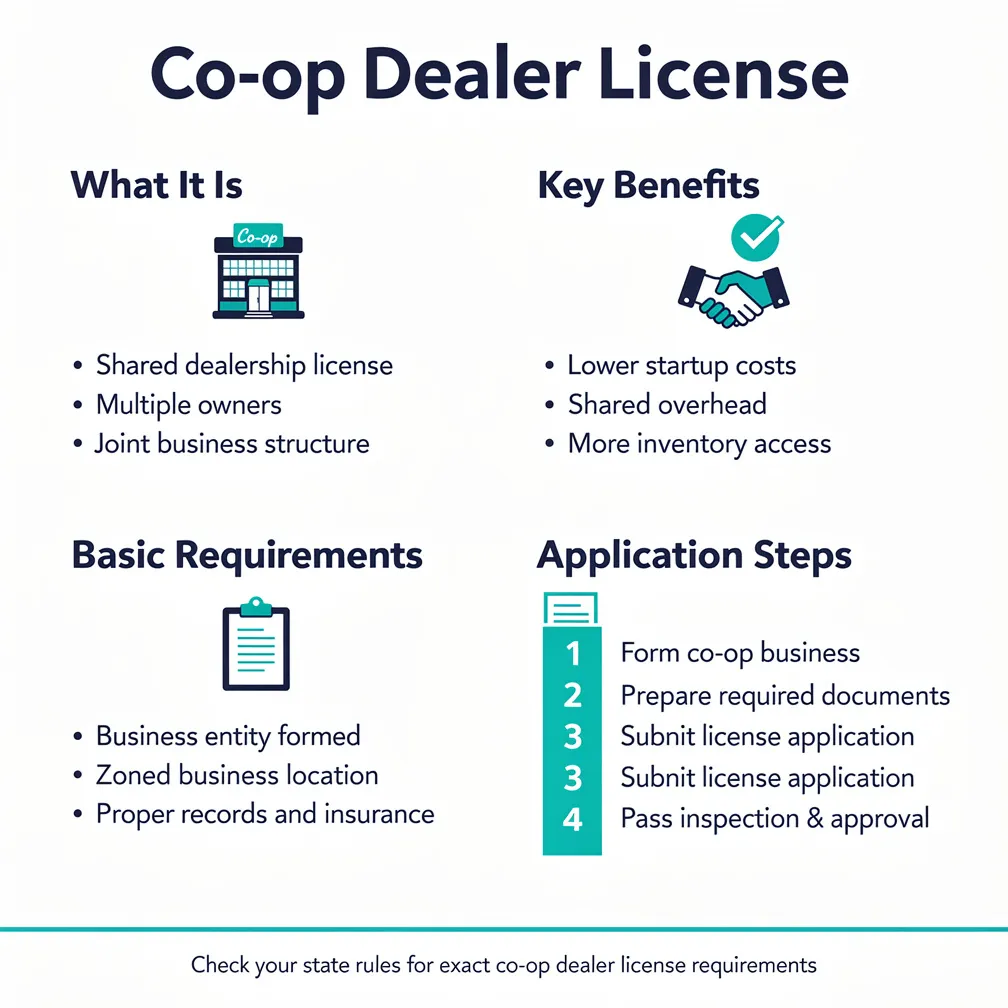
2. Get a Co-Op Dealer License
A co-op dealer license lets you operate under an established dealership’s license without needing your own physical lot, surety bond, or individual dealer license. You get:
- Legal authority to buy and sell unlimited vehicles
- Access to dealer-only auctions (Manheim, ADESA, Copart)
- Dealer plates for test drives and transport
- Ability to run title work under the dealership
- No lot, no zoning headaches, no $25,000 surety bond
This is by far the most popular option for car flippers who want to scale legally. My Car Dealer’s co-op program makes this process simple and affordable.
3. Consignment Arrangements
Some licensed dealers will sell cars on your behalf through consignment. You deliver the vehicle to their lot, they handle the sale, and you split the profit.
Pros: Completely legal, no license needed.
Cons: You lose 20-40% of your profit, have no control over pricing or timing, and your inventory sits on someone else’s lot.
4. Wholesale Only (Dealer-to-Dealer)
In some states, you can obtain a wholesale-only dealer license with lower requirements than a full retail license. This lets you buy at auction and sell to other dealers — but not to the public.
Requirements vary, but wholesale licenses typically don’t require a retail lot. The tradeoff: you can’t sell directly to consumers, which limits your profit margins.
5. Online Platforms with Dealer Partnerships
Some platforms partner with licensed dealers to let individuals list and sell vehicles legally. The platform handles compliance, title transfers, and paperwork through their dealer network.
This is the most hands-off option, but fees can eat 10-15% of your sale price, and you’re dependent on the platform’s terms and timelines.
The Risks of Selling Cars Without a License
Think you can fly under the radar? Here’s what happens when states catch unlicensed dealers — and they are catching them:
How they find you:
- DMV flags multiple title transfers to the same name
- Craigslist/Facebook Marketplace sting operations
- Buyer complaints to the state attorney general
- Insurance claims that reveal commercial activity
- Tax returns showing unreported vehicle sale income
Consequences of violating car flipping laws:
- Criminal charges: Misdemeanor in most states, felony in some for repeat offenders
- Fines: $500 to $25,000+ depending on state and number of violations
- Vehicle seizure: States can impound your inventory
- Tax penalties: IRS back taxes plus penalties on unreported income
- Civil liability: No lemon law protection means buyers can sue you personally
- Loss of driving privileges: Some states suspend your driver’s license
The worst part? You have zero legal protection as an unlicensed seller. If a buyer has a problem with a car you sold, you can’t hide behind corporate liability protections that licensed dealers enjoy.
The Co-Op Solution: Full Dealer Privileges, No Lot Required
A co-op dealer license through My Car Dealer eliminates every barrier that keeps car flippers operating in the shadows. Here’s how it works:
What you get:
- Operate legally under an established dealer license
- Buy at Manheim, ADESA, Copart, IAA, and other dealer-only auctions
- Access dealer pricing — save $2,000–$5,000 per vehicle vs. public auctions
- Dealer plates for legal test drives and vehicle transport
- Title processing handled for you
- No physical lot requirement
- No surety bond ($25,000–$50,000 saved)
- No individual dealer license application (which can take 3–6 months)
What it costs: A fraction of what you’d spend on your own dealership setup. Most independent dealer licenses require $10,000–$50,000+ in startup costs between bonds, lot leases, insurance, and state fees. A co-op membership is a simple monthly fee.
Who it’s for:
- Car flippers doing 5–50+ vehicles per year
- Side hustlers who want to scale without overhead
- Anyone tired of looking over their shoulder at the DMV
- Experienced flippers who want auction access to better inventory
How Much Can You Make Flipping Cars Legally?
With proper licensing and dealer auction access, the math changes dramatically:
Without a license (capped at 4-5 cars/year):
- Average profit per flip: $1,500–$3,000 (public market pricing)
- Annual potential: $6,000–$15,000
- Risk level: High (legal exposure on every sale)
With a co-op dealer license (unlimited volume):
- Average profit per flip: $2,500–$5,000+ (dealer auction pricing)
- Volume: 2–4 cars/month = 24–48 cars/year
- Annual potential: $60,000–$240,000+
- Risk level: Zero (fully legal and protected)
The difference isn’t just volume — it’s access to better inventory at lower prices. Dealer auctions consistently offer vehicles $2,000–$5,000 below what you’d pay on the public market. That alone can double your per-car profit.
Frequently Asked Questions
Can I sell cars from my home without a dealer license?
Yes, but only up to your state’s annual limit (typically 3–5 vehicles per year). Beyond that, you need a dealer license or co-op arrangement. Even within the limit, you must title the vehicle in your name before reselling in most states.
What happens if I get caught selling cars without a license?
Penalties range from misdemeanor charges and fines ($500–$25,000) to vehicle seizure and jail time. The DMV tracks title transfers, and states actively investigate individuals with multiple transfers per year.
How do states track how many cars I sell?
Through title transfer records at the DMV. Every time a vehicle is titled in your name and then transferred to someone else, it’s recorded. Some states use automated flagging systems that trigger when an individual exceeds the threshold.
Is car flipping legal if I pay taxes on the income?
Paying taxes doesn’t make unlicensed dealing legal. You must both pay taxes on vehicle sale profits AND stay within your state’s volume limits (or get properly licensed). These are separate legal requirements.
Can I use someone else’s dealer license to sell cars?
Only through a legitimate co-op or employee arrangement. Unofficially using someone’s license without proper paperwork is illegal and puts both parties at risk. A co-op dealer program like My Car Dealer provides the legal framework for this arrangement.
How quickly can I start selling cars with a co-op dealer license?
Through My Car Dealer’s co-op program, most members are set up and ready to buy at auction within days — not the 3–6 months it takes to obtain your own independent dealer license. Get started here.
Stop Looking Over Your Shoulder — Get Licensed Today
Every car you sell without proper licensing is a gamble — and the odds are getting worse as states invest in better detection and enforcement. The question isn’t whether you’ll get caught, it’s when.
My Car Dealer’s co-op dealer license program gives you everything you need to sell cars legally, access dealer-only auctions, and scale your business without the massive overhead of your own dealership.
→ Get started with your co-op dealer license today and turn your car flipping side hustle into a legitimate, scalable business.