Why Car Auctions Matter for Your Automotive Business
If you’ve ever wondered how professional car dealers consistently find high-quality inventory at below-market prices, the answer is simple: dealer-only auto auctions. These exclusive events represent one of the most significant advantages of holding a car dealer license, offering access to thousands of vehicles that the general public never sees.
Car auctions aren’t just about buying cars—they’re about transforming your automotive business model. Whether you’re looking to start a dealership, flip vehicles for profit, or simply expand your inventory options, understanding the auction ecosystem is essential.
What Are Dealer-Only Auto Auctions?
Dealer-only auto auctions are wholesale vehicle sales events restricted exclusively to licensed car dealers. Unlike public auctions where anyone can bid, these professional marketplaces require proof of an active dealer license to participate.
Types of Dealer Auctions
Physical Auctions: Traditional in-person events held at auction facilities across the country. Major players include:
- Manheim – The largest auto auction company in North America with over 70 locations
- ADESA – Another major auction network with facilities nationwide
- IAA (Insurance Auto Auctions) – Specializing in salvage and insurance vehicles
- Copart – Focused on salvage, insurance, and fleet vehicles
- Local/Regional Auctions – Smaller operations serving specific geographic areas
Online Dealer Auctions: Digital platforms that allow licensed dealers to bid remotely on vehicles from across the country. Many physical auction houses now offer hybrid experiences combining in-person and online bidding.
The Financial Advantage: Real Numbers
The profit potential at dealer auctions is substantial and measurable:
Average Price Differential: Vehicles at dealer auctions typically sell for $2,000 to $5,000 below retail market value. On higher-end vehicles, this gap can exceed $10,000.
Example Scenario:
- 2022 Honda Accord EX-L
- Retail market value: $28,500
- Typical auction price: $23,800
- Immediate equity: $4,700
After reconditioning costs of approximately $500-800, you’re still positioned with $3,900-4,200 in potential profit per vehicle. Dealers who move 5-10 vehicles monthly through auctions can generate $20,000-$40,000+ in monthly gross profit.
What Types of Vehicles Are Available?
The inventory diversity at dealer auctions is remarkable:
Trade-Ins from Franchise Dealerships
When customers trade vehicles at new car dealerships, those cars often go straight to auction rather than being retailed. These are typically well-maintained vehicles with clean histories.
Off-Lease Vehicles
Banks and leasing companies regularly auction returned lease vehicles. These cars usually have:
- Lower mileage (typically under 40,000 miles)
- Complete service records
- Known ownership history
- Predictable condition
Rental Fleet Vehicles
Major rental companies like Enterprise, Hertz, and Budget rotate their fleets annually, sending thousands of vehicles to auction. While they may have higher mileage, these vehicles are consistently maintained and represent excellent value.
Repossessions and Bank-Owned Vehicles
Financial institutions liquidate repossessed vehicles through dealer auctions. These often sell at steep discounts but require careful inspection.
Insurance Salvage (IAA, Copart)
Salvage auctions feature vehicles deemed total losses by insurance companies. These range from minor damage (hail, flood) to severe collision damage. This segment requires expertise but offers the highest profit margins.
Government and Municipal Fleet Vehicles
Police vehicles, municipal trucks, and government fleet cars are regularly auctioned. These are often high-mileage but mechanically sound.
How Dealer Auctions Actually Work
Registration and Credentials
Before bidding, you’ll need to:
- Present your dealer license – Your active dealer license is non-negotiable
- Complete auction registration – Provide business information and banking details
- Establish a credit line – Most auctions require a deposit or approved line of credit
- Obtain a bidder number – Your unique identifier for the auction
The Pre-Auction Process
Successful auction buyers arrive early to:
- Inspect vehicles – Walk the lot examining condition, features, and damage
- Review condition reports – Auction houses provide detailed inspection sheets
- Check vehicle history reports – Most auctions offer Carfax or AutoCheck access
- Set maximum bids – Determine your walk-away price before bidding starts
- Identify target inventory – Create a list of vehicles that fit your business model
The Bidding Experience
Physical Auctions: Vehicles drive through a lane while an auctioneer calls bids. The pace is rapid—30-60 seconds per vehicle. Bidders signal with hand gestures, nods, or their bidder card.
Online Auctions: Digital platforms allow real-time bidding from your computer or mobile device. You can set proxy bids (maximum amounts) and receive instant notifications when outbid.
After Winning a Bid
Once you win:
- Immediate payment or credit application – Purchased vehicles must be paid in full (or financed through the auction’s floor plan) within 24-48 hours
- Transportation arrangement – You can drive the vehicle away, hire a transport service, or use the auction’s delivery options
- Title processing – The auction handles title transfer paperwork
- Arbitration window – Most auctions offer 3-7 days to return vehicles with undisclosed issues
The Dealer License Requirement: Why It Exists
Dealer auctions maintain strict licensing requirements for several important reasons:
Legal Title Transfer
Only licensed dealers can legally process wholesale title transfers. This ensures proper documentation and prevents title fraud.
Professional Standards
Licensing requirements ensure participants understand automotive regulations, consumer protection laws, and professional conduct standards.
Arbitration and Disputes
The auction arbitration system relies on participants being licensed professionals who understand industry standards and vehicle conditions.
Tax and Regulatory Compliance
Licensed dealers are registered with state revenue departments, ensuring proper sales tax collection and regulatory oversight.
Public Auctions vs. Dealer Auctions: The Key Differences
| Factor |
Dealer Auctions |
Public Auctions |
| Entry Requirement |
Valid dealer license required |
Open to anyone |
| Vehicle Selection |
Thousands of vehicles weekly |
Limited selection |
| Average Prices |
$2,000-$5,000 below retail |
Near retail value |
| Buyer’s Premium |
$100-$400 per vehicle |
10-15% of purchase price |
| Arbitration Protection |
Full arbitration system (3-7 days) |
As-is, limited recourse |
| Vehicle History |
Complete reports provided |
Limited or none |
| Title Transfer |
Streamlined wholesale process |
Retail title, longer processing |
The financial difference is stark. At public auctions, you’re competing with retail buyers who bid up to market value, plus you pay a premium fee. At dealer auctions, you’re buying wholesale with professional pricing.
How to Maximize Your Auction Success
1. Develop Inspection Skills
Learn to quickly assess:
- Body panel alignment (indicating previous collision repair)
- Paint quality and consistency
- Tire wear patterns (alignment issues)
- Interior condition and odors
- Under-hood cleanliness and fluid conditions
- Service stickers and maintenance indicators
2. Understand Market Values
Before bidding, know:
- Current retail pricing – Check KBB, NADA, and local listings
- Reconditioning costs – Factor in detailing, minor repairs, and inspection fees
- Transportation expenses – Include shipping or drive-away costs
- Your target profit margin – Typically 20-30% of retail price
3. Specialize Initially
New auction buyers should focus on:
- Specific makes/models you know well
- Popular, fast-turning inventory (Toyota, Honda, Ford trucks)
- Vehicles with strong local demand
- Price ranges matching your target customer base
4. Build Auction Relationships
Develop connections with:
- Auction representatives who can alert you to incoming inventory
- Other dealers for market intelligence
- Transportation companies for reliable, cost-effective shipping
- Reconditioning services near auction locations
5. Use Arbitration When Necessary
Don’t hesitate to file arbitration claims for:
- Undisclosed mechanical issues
- Frame damage not listed in condition reports
- Title problems
- Odometer discrepancies
Auctions maintain strong arbitration systems to protect dealer buyers. Use them.
Common Auction Mistakes to Avoid
Emotional Bidding
The rapid pace and competitive atmosphere can trigger emotional bidding. Set your maximum price before bidding starts and stick to it. There will always be another vehicle.
Skipping Inspections
Never bid on vehicles sight unseen (unless you’re very experienced with online auctions and detailed condition reports). A 5-minute inspection can save thousands in repair costs.
Ignoring Transportation Costs
A great deal 800 miles away becomes mediocre after $500 in shipping costs. Factor this into your maximum bid.
Over-Extending Credit
Auction floor plans (dealer financing) offer convenience but carry interest costs. Don’t tie up too much credit on slow-moving inventory.
Buying Outside Your Expertise
Exotic cars, luxury vehicles, and diesel trucks require specialized knowledge. Stick with what you know until you build expertise.
Online Dealer Auctions: The Digital Revolution
The auction landscape has transformed dramatically with online platforms:
Major Online Auction Platforms
- Manheim.com – 5+ million vehicles annually
- ADESA Simulcast – Real-time bidding on physical auction lanes
- ACV Auctions – Mobile-first, 20-minute digital auctions
- OVE – Online Vehicle Exchange with condition reports
- BacklotCars – Dealer-to-dealer marketplace
Advantages of Online Bidding
- Geographic reach – Access inventory from across the country
- Time efficiency – Bid from your office or phone
- Detailed condition reports – Often more thorough than physical inspections
- Proxy bidding – Set maximum bids and let the system bid for you
- Saved searches – Get alerts when specific vehicles become available
Online Auction Challenges
- Can’t physically inspect vehicles before bidding
- Must trust condition reports and photos
- Transportation logistics are more complex
- Competition can be more aggressive with broader dealer participation
The Economics of Auction Buying: A Real Business Case
Let’s examine a realistic monthly scenario for a small dealer leveraging auctions:
Monthly Auction Activity
Vehicles Purchased: 8 vehicles per month
Average Purchase Price: $12,500 per vehicle
Total Acquisition Cost: $100,000/month
Average Reconditioning: $600 per vehicle
Total Reconditioning: $4,800/month
Average Sale Price: $16,800 per vehicle
Total Revenue: $134,400/month
Profitability Breakdown
- Gross Profit: $29,600/month ($3,700 per vehicle)
- Operating Expenses: $8,000/month (lot, insurance, licensing, marketing)
- Net Profit: $21,600/month
- Annual Net Profit: $259,200
This modest operation, buying just 2 vehicles per week at auction, generates over $250,000 in annual net profit. Scale this up, and the potential becomes even more significant.
Special Auction Categories Worth Exploring
Charity and Estate Auctions
These specialized events feature donated vehicles, often from estates or charitable organizations. Prices can be exceptionally low due to the donor-motivation rather than profit-driven sales.
Exotic and Classic Car Auctions
High-end auctions (Mecum, Barrett-Jackson, RM Sotheby’s) require dealer credentials and offer access to collectible vehicles. The profit margins are larger but so are the risks and capital requirements.
Fleet Auctions
Large corporate fleets (rental companies, telecommunications, utilities) often hold dedicated auctions. These feature high-mileage but well-maintained vehicles at exceptional prices.
Salvage Auctions
Insurance salvage auctions (Copart, IAA) represent the highest-risk, highest-reward category. Vehicles range from minor hail damage to complete losses. This segment requires expertise in repair cost estimation.
Getting Started: Your Action Plan
Ready to access the dealer auction market? Here’s your roadmap:
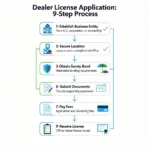
Step 1: Obtain Your Dealer License
The first requirement is securing your car dealer license. This process varies by state but typically includes:
- Business entity formation (LLC, corporation, sole proprietorship)
- Business location meeting state requirements
- Surety bond
- License application and fees
- Background check
This is where we help. My Car Dealer License specializes in guiding entrepreneurs through the dealer licensing process, making it faster, easier, and more affordable than navigating the bureaucracy alone.
Step 2: Register with Auction Houses
Once licensed:
- Contact major auction houses (Manheim, ADESA) in your area
- Complete registration paperwork
- Provide license documentation
- Establish credit lines or deposit accounts
Step 3: Attend Your First Auction as an Observer
Before bidding:
- Visit an auction to observe the process
- Watch experienced dealers inspect vehicles
- Note bidding patterns and final sale prices
- Ask questions of auction staff
Step 4: Start Small
Your first purchases should be:
- Lower-risk vehicles in the $5,000-$10,000 range
- Makes/models you’re familiar with
- Clean-title, non-salvage vehicles
- Popular models with strong local demand
Step 5: Build Systems
As you gain experience, develop:
- Vehicle valuation spreadsheets
- Trusted transportation contacts
- Reconditioning service relationships
- Inventory management processes
The Bottom Line: Why Dealer Auctions Transform Businesses
Access to dealer-only auto auctions represents one of the most significant competitive advantages in the automotive industry. The combination of wholesale pricing, massive inventory selection, and professional arbitration systems creates an opportunity that simply doesn’t exist in public markets.
For entrepreneurs serious about entering the car business—whether as a full-time dealership, part-time side business, or vehicle flipping operation—dealer auction access is not optional. It’s essential.
The math is compelling: $2,000-$5,000 below retail pricing per vehicle × consistent monthly volume = substantial profit potential.
But it all starts with one critical requirement: an active car dealer license.
Ready to Access Dealer-Only Auctions?
The path to auction access begins with your dealer license. While the process can seem complex—business formation, bonding, applications, inspections—it’s absolutely achievable with proper guidance.
My Car Dealer License exists to simplify this journey. We’ve helped hundreds of entrepreneurs navigate the licensing process, turning bureaucratic confusion into a straightforward path to auction access.
Whether you’re looking to start a traditional dealership, launch a vehicle flipping business, or simply gain access to wholesale inventory, your dealer license opens the door.
Get Started with Your Dealer License
The car auction market represents billions in annual vehicle transactions. With your dealer license, you’ll have full access to this wholesale ecosystem—buying inventory at prices the public never sees and building a profitable automotive business on wholesale margins.